

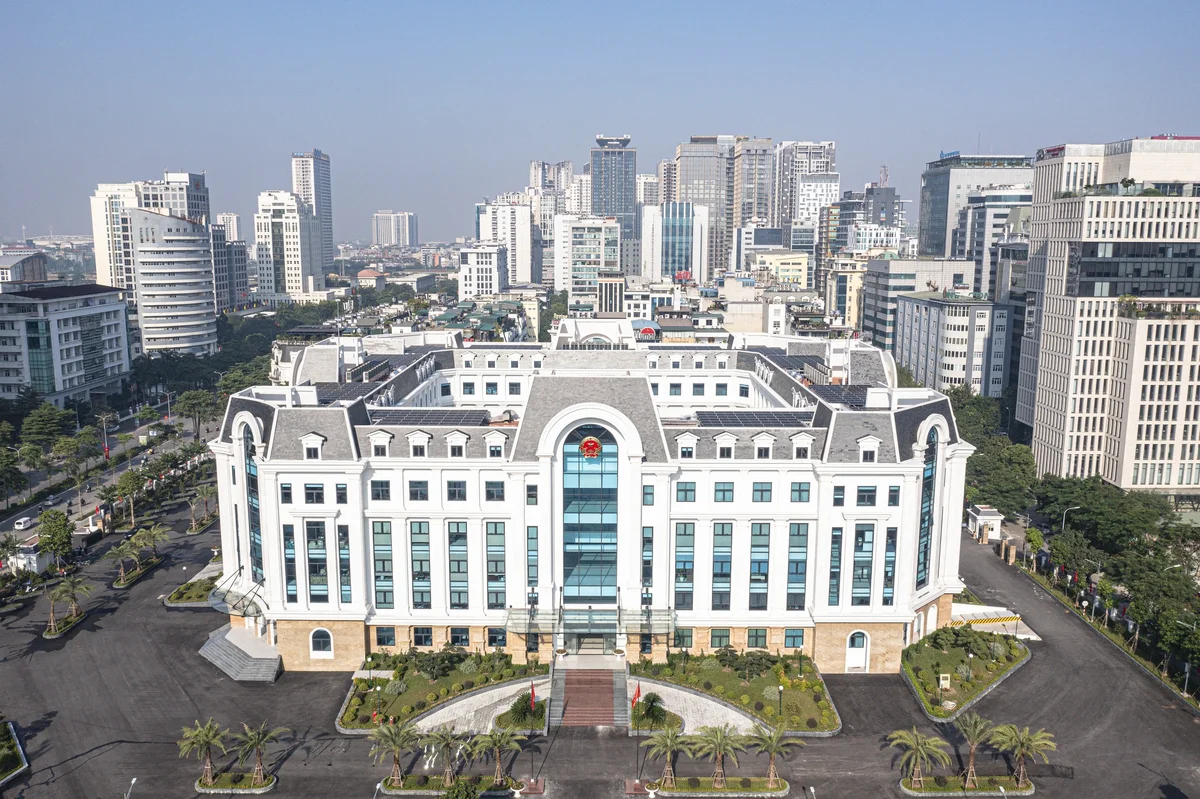
The abolition of the intermediate administrative level (districts, urban districts and towns) has enabled Hanoi to substantially streamline its administrative apparatus by reducing the number of commune-level administrative units from 526 communes, wards and townships to 126. The study evaluates the achievements attained after one year of implementation, including strengthening the connection between local government and citizens, advancing decentralization and delegation of authority and accelerating the development of digital infrastructure. At the same time, the article identifies several institutional bottlenecks, particularly those related to the interoperability of integrated data systems and the increasing pressure on the implementation capacity of grassroots officials. Based on these findings, the author proposes a set of policy recommendations aimed at fostering innovation in modern public governance by shifting from a traditional administrative management approach to development-oriented, data-driven governance supported by digital technologies and artificial intelligence (AI), thereby meeting Hanoi's requirements for breakthrough development in the new era.
Keywords: Two-tier local government; Local governance; Administrative streamlining; Decentralization and delegation of authority; Hanoi; Governance innovation.
INTRODUCTRION
Hanoi, the capital of Vietnam and the nation's political and administrative center, as well as a major hub for culture, science, education, economic activities and international exchange, is facing unprecedented development challenges driven by rapid urbanization and sustained population growth through migration. Addressing bottlenecks in infrastructure, environmental management and social governance requires comprehensive institutional reform, with particular emphasis on establishing a local government system that is compatible with the distinctive characteristics of a modern metropolitan area. Consequently, reforming the organization of local government has become both an objective necessity and an urgent priority.
Resolution No. 15-NQ/TW, issued by the Politburo on 5 May 2022 on the orientations and tasks for the development of Hanoi to 2030, with a vision to 2045, provides a clear strategic direction for building a streamlined, effective and efficient local government system. The official implementation of the two-tier local government system in Hanoi's urban areas represents not only a major institutional breakthrough but also a fundamental step toward transforming the governing model from a traditional administrative government to a modern urban governance system.
This article examines the theoretical and practical foundations of the two-tier local government model in Hanoi, evaluates the outcomes and institutional challenges arising from the pilot implementation of the model without People's Councils at the ward level and proposes strategic policy recommendations to foster governance innovation and strengthen the governance capacity of the capital in the new development era.
I. RESTRUCTURING HANOI’S LOCAL GOVERNMENT SYSTEM UNDER THE TWO-TIER GOVERNANCE MODEL
The implementation of the two-tier local government system in Hanoi represents far more than an administrative reorganization aimed at streamlining territorial units. It reflects a profound transformation in the philosophy of public governance, oriented toward building a modern, effective, efficient and citizen-centered administrative system. From the perspective of public administration theory, this reform constitutes a comprehensive restructuring of the local government system, simultaneously affecting institutional design, the distribution of governmental authority, organizational arrangements and the delivery of public services.
From an organizational perspective, Hanoi has completed the consolidation of its 526 communes, wards and townships into 126 communes and wards, while simultaneously abolishing the former 30 district-level administrative units, including urban districts, rural districts, and the town. Parallel to this restructuring, the city comprehensively reorganized the Party apparatus, local government institutions, the Vietnam Fatherland Front, and socio-political organizations within the newly established administrative units. Thousands of leadership and managerial officials were reviewed, reassigned, transferred and redeployed to ensure the effective operation of the new organizational structure. Notably, the pilot operation conducted prior to official implementation significantly minimized institutional disruption during the transition, ensuring the continuity of state administration, preventing leadership vacuums and avoiding interruptions in the provision of services to citizens and businesses.
Under the previous administrative model, district-level governments performed not only sectoral state management functions but also served as intermediary authorities responsible for transmitting policies and coordinating activities between the municipal government and grassroots administrations. The elimination of this intermediate tier has substantially shortened decision-making processes, reduced administrative procedures, minimized overlapping responsibilities and enhanced the responsiveness of public policy. These improvements are particularly significant for a special metropolitan area such as Hanoi, where rapid urbanization and continuous population growth require increasingly agile, timely and flexible governance.
Whereas many administrative responsibilities were previously concentrated at the intermediate level, the new organizational model shifts decisively toward empowering the level of government closest to citizens while strengthening mechanisms for oversight, supervision and accountability. Accordingly, Hanoi conducted a comprehensive review of 2,007 state management functions across 14 policy sectors to redefine the distribution of authority among different levels of government. Following the implementation of decentralization, delegation of authority and administrative authorization, 926 state management functions were assigned to commune-level governments. In addition, 661 administrative procedures were transferred from the municipal government and specialized departments to the grassroots level, enabling local authorities to provide services directly to citizens and businesses.
These figures illustrate a substantial transformation in the distribution of administrative authority at the local level. Rather than maintaining a centralized governance structure, Hanoi is gradually transitioning toward a model of controlled decentralization, under which grassroots governments are no longer merely implementing agencies but are becoming governance actors with broader functional responsibilities and greater decision-making authority. This transformation has given rise to an expanded-function grassroots government model, in which communes and wards are entrusted with greater powers in population management, administrative service delivery, public service provision and the resolution of local issues. Decentralization also enables administrative decisions to be made closer to the affected communities, thereby enhancing both the relevance and effectiveness of public policies.
From a theoretical perspective, these reforms closely align with the principles of New Public Management (NPM), which emphasize organizational streamlining, the reduction of bureaucratic layers, greater managerial autonomy for implementing agencies and stronger accountability in public administration. Hanoi's restructuring of its local government system through the elimination of intermediate administrative levels and the expansion of grassroots authority demonstrates an increasingly systematic application of modern governance principles within Vietnam's institutional context. Rather than concentrating administrative power at intermediary levels, the new model seeks to strengthen the self-governing capacity of local authorities and their ability to address public issues at the point where they arise.
Moreover, viewed through the lens of Multi-level Governance (MLG) theory, the two-tier local government model establishes a more direct relationship between government and citizens. By reducing institutional distance, social demands, citizens’ feedback and emerging local issues can be communicated more rapidly to the competent authorities. This institutional arrangement not only enhances governance effectiveness but also strengthens transparency, promotes greater public participation in state governance and facilitates a shift toward an interactive governance model rather than one based solely on hierarchical administrative control.
Overall, the implementation of the two-tier local government system marks a significant transition from a multi-layered urban administrative structure to a governance model that is more streamlined, flexible and citizen-oriented. Given its scale, strategic importance and national influence, Hanoi is emerging as a representative case of administrative reform in Vietnam, providing valuable practical experience for the continued refinement of the local government system in the country's new stage of development.
II. OPERATIONAL EFFECTIVENESS OF THE TWO-TIER LOCAL GOVERNMENT SYSTEM IN HANOI
Following the restructuring of its administrative apparatus and the reconfiguration of its decentralization and delegation framework, Hanoi's two-tier local government system has begun to demonstrate positive outcomes across multiple dimensions, including public administration, organizational performance, socio-economic governance and modern urban governance.
The most immediate and visible benefits have been observed in the field of public administration. The expansion of decentralization and delegated authority has significantly reduced the institutional distance between government agencies and citizens while improving the operational efficiency of the administrative system. According to official statistics, between 1 July 2025 and 31 January 2026, Hanoi processed more than 2.26 million administrative applications under the decentralized and delegated governance framework. The rate of applications resolved on or ahead of schedule reached 95.77%, while the average processing time was reduced by three to five days compared with the period before the implementation of the new governance model.
From the perspective of public administration, these achievements demonstrate substantial improvements in both the effectiveness and efficiency of the two-tier local government system. Under the traditional administrative structure, a single application typically passed through multiple intermediary levels - from the grassroots level to district authorities before being reviewed, processed or approved. This multi-layered process often prolonged administrative procedures, increased the risk of overlapping responsibilities and generated unnecessary administrative costs. By transferring a wide range of decision-making authority directly to commune - and ward - level governments, Hanoi has significantly shortened administrative workflows, enabling decisions to be made more rapidly, respond more effectively to local realities, and substantially reduce institutional lag - one of the principal factors undermining the effectiveness of public administration. Furthermore, allowing citizens and businesses to complete administrative procedures directly within their local communities has considerably lowered transaction costs, including travel expenses, time, opportunity costs and other resources associated with administrative compliance. From the perspective of institutional economics, reducing transaction costs not only improves the efficiency of public service delivery but also enhances the allocation of social resources, improves the investment and business environment and creates stronger momentum for socio-economic development.
The socio-economic benefits of the two-tier local government system are clearly reflected in the measurable gains generated by the reform. Hanoi estimates that decentralization and delegated authority resulted in social cost savings of approximately VND 63.5 billion during the first seven months of implementation. During the first four months of 2026 alone, the estimated savings exceeded VND 37 billion.
International experience demonstrates that successful administrative reforms generate broader economic impacts by reducing compliance costs, shortening administrative procedures and enhancing the predictability of institutional environments. In Hanoi, the delegation of administrative procedures in areas such as land administration, construction, investment and business registration has significantly shortened processing times, reduced waiting periods for businesses and accelerated the implementation of investment projects. This is particularly important in an increasingly competitive environment for attracting investment, where institutional quality and administrative efficiency have become critical determinants of local competitiveness. In other words, the effectiveness of public governance can be translated into tangible economic value, giving rise to what may be described as the financialization of administrative reform benefits an approach increasingly adopted internationally to ensure that governance reforms not only improve administrative performance but also make direct contributions to economic growth and sustainable development.
Beyond administrative and economic improvements, the two-tier governance model has also generated significant organizational changes within Hanoi's local government system. To ensure the stable operation of the new institutional framework from the outset, the Hanoi People's Council promptly adopted 377 resolutions appointing key personnel at the commune level. In addition, a comprehensive operational guidance package consisting of 22 annexes covering council meetings, administrative procedures, coordination mechanisms, and professional operations was developed and disseminated uniformly across the newly established administrative units. Continuous online support mechanisms, regular professional guidance and expanded applications of information technology in administrative management have further strengthened the effectiveness of the transition.
Particularly given Hanoi's status as a special municipality covering more than 3,344km² and serving a population of approximately 8.9 million, the effectiveness of the two-tier local government model also lies in its capacity to establish the institutional foundation for modern urban governance. Whereas governance previously relied primarily on conventional administrative procedures, the current reform links extensive decentralization at the grassroots level with the digitalization of public data, interoperability among information systems and the broader application of digital technologies in public administration. These developments create favorable conditions for shifting from a traditional administrative management model to data-driven governance.
A comprehensive, continuously updated and interoperable data system enables government authorities to better anticipate emerging social challenges, optimize the allocation of public resources and improve the quality of policy decisions. The integration of the two-tier local government system with digital transformation initiatives demonstrates that Hanoi is progressively moving toward a data-driven governance model, in which administrative decisions are informed not only by managerial experience but also by real-time data and advanced analytical tools. This transformation reflects a broader global trend among major metropolitan areas, where the Fourth Industrial Revolution is fundamentally reshaping approaches to public governance and state administration.
III. GRASSROOTS GOVERNMENT MODELS: CASE STUDIES FROM HANOI’S PRACTICAL EXPERIENCE
The implementation of the two-tier local government system in Hanoi demonstrates that many localities have proactively adopted innovative governance approaches, strengthened the autonomy of grassroots governments and developed creative public service models. Minh Chau Commune and Xuan Phuong Ward are two representative case studies. Although they have pursued different approaches, both share the common objective of building a service-oriented administration that places citizens at the center of local development.
In Minh Chau Commune, the two-tier local government model has enabled grassroots authorities to exercise greater initiative in designing and implementing community-oriented policies. The most notable achievement is the development of a comprehensive social welfare and healthcare model. Minh Chau became the first commune in Vietnam to provide health examinations for its entire population while simultaneously completing electronic health records for 100% of its residents. In addition, the commune allocated nearly VND 4 billion to support policy beneficiaries, disadvantaged households, and a wide range of social welfare programs. The policy of providing free ferry services for all upper secondary school students illustrates the local government's direct responsiveness to the essential needs of its residents. Collectively, these initiatives demonstrate a shift from a traditional administrative approach focused on population management toward a people-centered governance model in which citizens are viewed not merely as subjects of administration but as the central beneficiaries of public governance.
Beyond social welfare, Minh Chau also illustrates how greater autonomy at the grassroots level can stimulate local economic development. The introduction of Bus Route 20ATC has significantly improved transport connectivity, facilitating travel, education, employment and commercial activities for local residents. For a locality that had long faced limitations in transportation access, this initiative represents an important breakthrough, narrowing the development gap between peripheral areas and the urban center while enabling the commune to participate more actively in the capital city’s economic activities.
Another noteworthy initiative is the redevelopment of Minh Chau Market in conjunction with a new bus transfer hub, creating a modern commercial and service space while supporting the development of a night market targeting tourists. This transformation has generated new employment opportunities, increased local incomes, and opened up prospects for developing the nighttime economy an area that has attracted growing attention among metropolitan governments seeking to maximize the utilization of local economic resources.
One of Minh Chau's most innovative practices is the “Two-Service Government” model. In addition to their regular office hours, government officials and civil servants visit residential communities and households during the evening to assist citizens with administrative procedures, receive complaints and recommendations and gain a better understanding of local concerns. This initiative represents a significant departure from the traditional relationship between government and citizens. Rather than requiring citizens to visit government offices, local authorities proactively bring public services directly to the community, thereby reducing procedural barriers, improving access to public services and enhancing administrative responsiveness. The model clearly embodies the principle of being close to the people, responsive to the people and serving the people, while illustrating the increasingly service-oriented character of grassroots governance.
Xuan Phuong Ward, by contrast, represents an emerging model of governance innovation in a modern urban environment. Here, the implementation of the two-tier local government system has been closely integrated with administrative reform and digital transformation. Numerous administrative procedures have been reviewed, simplified and digitized, resulting in shorter processing times, greater transparency, and lower compliance costs for both citizens and businesses. The ward government has also placed strong emphasis on public dialogue, citizen engagement and the timely resolution of community feedback. This approach reflects a transition from traditional administrative management toward an interactive governance model characterized by active citizen participation. Residents are no longer merely recipients of public policies but have become active participants in policy consultation, public oversight, and collaborative problem-solving alongside local authorities. Through the continued digitalization of administrative processes, expanded application of information technologies and broader provision of online public services, Xuan Phuong is progressively developing a modern ward-level urban governance model capable of meeting the demands of digital transformation and rapid urbanization.
While Minh Chau is distinguished by its people-centered approach emphasizing social welfare and quality of life, Xuan Phuong exemplifies a modern urban governance model built upon digital platforms and citizen engagement. Together, these practical experiences demonstrate that, when granted appropriate authority and supported by flexible institutional mechanisms, grassroots governments are fully capable of becoming innovative actors in local governance. Their experiences provide compelling evidence that empowered local governments can make substantial contributions to building a modern, effective, efficient and service-oriented public administration.
IV. STRATEGIC POLICY RECOMMENDATIONS FOR ENHANCING THE EFFECTIVENESS OF HANOI'S TWO-TIER LOCAL GOVERNMENT SYSTEM
To fully realize the governance objectives of the two-tier local government system, Hanoi should implement a comprehensive package of strategic and transformative policy measures encompassing institutional reform, organizational restructuring, fiscal innovation and digital governance.
* Institutional and legislative reform
Hanoi should fully leverage the special institutional mechanisms provided under the capital law by translating them into specific local legal instruments adopted by the Hanoi people's council. In particular, the city should be granted greater discretion in determining the number of civil servants and public employees based on population size, economic development and local administrative characteristics, rather than being constrained by nationally uniform staffing ceilings.
In addition, a standardized operational handbook should be developed to clearly define the responsibilities and authority of ward-level People's Committees, specify the functions they are authorized to perform, identify those beyond their jurisdiction, and establish corresponding financial resources to support delegated responsibilities. Such a framework would help prevent situations in which responsibilities are transferred without adequate financial support or exceed the legal and institutional capacity of ward-level governments.
Organizational Restructuring and Human Resource Development
The allocation of staffing for ward-level governments should be determined according to population size and the complexity of administrative responsibilities, rather than applying a uniform staffing formula across all localities. Wards should therefore be classified into different categories - for example, Special Category (more than 50,000 residents), Category I, and Category II - with staffing levels calibrated accordingly.
At the same time, systematic training and retraining programs should be provided for chairpersons, vice-chairpersons, and professional civil servants at the ward level, focusing on modern urban governance, data analytics, digital administration, and crisis communication management. A regular rotation mechanism should also be established to enable civil servants to move periodically between specialized municipal departments and ward-level People's Committees. Such a mechanism would strengthen practical administrative experience while reducing institutional insularity and mitigating the risk of local interest groups emerging within grassroots administrations.
Fiscal and budgetary reform
Greater fiscal autonomy should be granted to commune- and ward-level governments. Rather than allocating financial resources primarily on the basis of staffing levels, operating budgets and salary funds should increasingly be determined according to performance outcomes, including service quality and citizen satisfaction.
Furthermore, ward governments should be permitted to retain an appropriate share of locally generated revenues including land-use fees and taxes derived from local production and business activities to finance investments in technical infrastructure and local public services. Such fiscal decentralization would reduce dependence on budget allocations from the municipal government while enhancing local governments' capacity to respond proactively to development priorities.
Digital infrastructure and data-driven governance
Hanoi should make substantial investments in developing an integrated digital governance platform serving the entire city. All online public services provided at the ward, municipal and city levels should be integrated into a unified national one-stop electronic service portal, ensuring seamless access and interoperability across administrative levels.
The city should also establish an integrated system for monitoring social media and collecting citizen feedback in real time. Such a platform would enable municipal authorities to identify emerging public concerns - including flooding, waste management, environmental pollution and noise disturbances - at the neighborhood level, thereby facilitating early intervention by grassroots authorities before localized issues escalate into broader governance crises or large-scale public complaints.
Collectively, these strategic measures would not only improve the operational effectiveness of Hanoi’s two-tier local government system but also accelerate the city's transition toward a modern, data-driven, citizen-centered and digitally enabled model of urban governance capable of meeting the demands of sustainable development in the digital era.
CONCLUSION
The implementation of the two-tier local government system in Hanoi marks a significant milestone in the city's efforts to reform its administrative structure and modernize local governance. By streamlining the organizational apparatus, eliminating intermediate administrative levels and strengthening decentralization and the delegation of authority, Hanoi is gradually establishing a governance model that is better aligned with the development needs of a special metropolitan city in the context of digital transformation and deeper international integration.
Practical experience from the first stage of implementation indicates that the two-tier governance model has generated positive outcomes across multiple dimensions. Administrative procedures have become more efficient, processing times have been significantly shortened and social costs have been reduced, while the satisfaction levels of both citizens and businesses have steadily improved. At the same time, the expanded application of information technology, wider provision of online public services and accelerated digitalization of administrative data have enhanced transparency, openness and accountability in public administration.
From a theoretical perspective, the reforms taking place in Hanoi reflect a broader transition from a traditional administrative government toward a service-oriented government and from conventional bureaucratic administration to a governance model driven by data, digital technologies and active citizen engagement. To ensure the long-term sustainability of this transformation, Hanoi should continue to refine its decentralization framework, strengthen the capacity of grassroots officials, develop an integrated data infrastructure and accelerate the construction of a smart city ecosystem. These factors will be essential to consolidating the effectiveness of the two-tier local government system and enabling it to make a lasting contribution to the development of Hanoi as a modern, civilized and sustainable capital city.
MA. Nguyen Ha Linh
REFERENCES
- Hanoi Party Committee Standing Board. (2026). Report on the one-year Review of the operation of the Political system and the two-tier local government system in Hanoi.
- Ministry of Home Affairs. (2025). Theoretical and practical foundations for building the two-tier local government system in Vietnam. State Management Review.
- Nguyen Duy Ngoc. (2026). Orientations for improving the organizational structure, governance mechanisms and development of the capital in the new era. Paper presented at the National Scientific Conference, Hanoi.
- National Assembly of the Socialist Republic of Vietnam. (2024). Capital Law (Revised). National Political Truth Publishing House.