

ABSTRACT
Divergent interpretations are a persistent and pedagogically challenging phenomenon in reading comprehension classrooms. Such diversity is frequently attributed to students’ misunderstanding or insufficient reading skills, leading teachers to prioritize interpretive convergence and correct answers. This article argues that divergent interpretations are not pedagogical failures but an inherent outcome of the reading process itself. Drawing on Wolfgang Iser’s concept of textual gaps and indeterminacy, the paper explains how literary texts structurally invite multiple acts of meaning-making. At the same time, insights from Norman Holland’s identity-based reader-response theory illuminate why individual students respond differently to the same textual openness. By synthesizing these perspectives, the article proposes a complementary framework that links textual indeterminacy with identity-driven reader responses in classroom contexts. The discussion demonstrates how an exclusive focus on either textual structure or reader subjectivity can result in interpretive imposition or unregulated relativism. The article concludes by outlining pedagogical implications for reading comprehension instruction, highlighting how teachers can design reading tasks that both foreground textual gaps and productively engage students’ diverse interpretive identities.
Keywords: reading comprehension; divergent interpretations; textual gaps; reader response; identity-based reading
1. Introduction
In contemporary reading classrooms, divergent interpretations of the same literary text are a recurrent and often contested phenomenon. While curriculum documents and pedagogical frameworks increasingly emphasize student-centred, dialogic, and meaning-oriented approaches to reading, teachers frequently experience interpretive diversity as a practical dilemma: multiple, sometimes conflicting readings raise questions about instructional effectiveness, assessment criteria, and the boundaries of acceptable interpretation.
Within educational discourse, divergent interpretations are commonly framed in two opposing ways. From a text-oriented perspective, variation in students’ readings is often attributed to insufficient comprehension, weak textual grounding, or instructional failure to guide students toward more “accurate” meanings. From a reader-oriented perspective, especially in traditions influenced by reader-response theory, interpretive diversity is frequently celebrated as evidence of personal engagement and subjective meaning-making. However, both positions tend to remain pedagogically under-specified: the former risks reducing reading to convergence on authorized meanings, while the latter often struggles to articulate principled criteria for evaluating interpretations in classroom contexts.
This article argues that divergent interpretations in reading classrooms should be understood not as instructional failure, but as a theoretically intelligible outcome of the interaction between textual indeterminacy and reader identity. Rather than treating interpretive variation as either error or unrestricted subjectivity, the article proposes that divergence emerges from the structured openness of literary texts and the identity-based investments readers bring to the act of reading.
To develop this argument, the study brings into dialogue two influential but rarely integrated theoretical traditions. Drawing on Wolfgang Iser’s concept of textual gaps and indeterminacy, reading is understood as an active process in which meaning is constructed through the reader’s engagement with what the text leaves unsaid. At the same time, Norman Holland’s identity-based reader-response theory foregrounds how readers’ psychological dispositions, experiences, and self-concepts shape the ways they fill these gaps. While each framework has been widely discussed in literary theory and reading research, they are often applied separately, resulting in partial explanations of interpretive diversity that privilege either textual structure or reader subjectivity.
By integrating Iser’s account of textual indeterminacy with Holland’s concept of identity response, this article proposes a complementary theoretical framework for understanding why and how students arrive at divergent interpretations in reading classrooms. This framework does not seek to resolve interpretive differences by prescribing correct meanings, nor does it abandon evaluative judgment altogether. Instead, it offers a principled way to conceptualize interpretive divergence as a predictable outcome of reading, with important implications for instructional design, classroom discussion, and assessment.
The article is conceptual in nature and focuses on literary reading in secondary and tertiary education contexts. Its primary contribution lies in reframing interpretive divergence as a pedagogically productive phenomenon rather than a problem to be eliminated. By clarifying the theoretical logic behind divergent interpretations, the study aims to support teachers in designing reading instruction and assessment practices that acknowledge both textual constraints and reader diversity, without collapsing into relativism or rigid standardization.
2. From Textual Gaps to Identity Responses: A Complementary Framework
Reading comprehension in literary classrooms is more adequately explained when divergent interpretations are understood not as pedagogical deficiencies, but as the outcome of a theoretically structured interaction between textual indeterminacy and reader-specific modes of response.Rather than positioning interpretive diversity as a problem to be resolved through convergence, this section advances a complementary framework that links textual gaps with identity-based reader responses, drawing on the reception theory of Wolfgang Iser and the reader-response theory of Norman Holland.
2.1. Textual gaps as conditions for interpretive plurality
In The Act of Reading, Iser conceptualizes literary texts as structures that generate meaning only through reader participation. Meaning is neither an intrinsic property of the text nor a purely subjective projection of the reader; it emerges through the interaction between these two poles (Iser, 1978, pp. 20–21). Central to this interaction is the notion of indeterminacy, operationalized through what Iser terms blanks or gaps. These gaps disrupt textual continuity and compel readers to establish connections that are not explicitly given, thereby initiating acts of meaning-construction (Iser, 1978, pp. 182–184).
Crucially, gaps do not license interpretive arbitrariness. They function within the constraints of the text’s repertoire—its cultural references, narrative conventions, and formal strategies—which delimit the range of plausible interpretations (Iser, 1978, pp. 68–72). Interpretive plurality is therefore structurally invited but institutionally governable. As Iser emphasizes, the aim of a theory of aesthetic response is not to privilege a single interpretation, but to provide “a framework which enables us to assess individual realizations and interpretations of a text in relation to the conditions that have governed them” (Iser, 1978, p. 10).
From this perspective, divergent interpretations in classrooms are not the result of textual vagueness or reader error. They are the predictable consequence of texts designed to activate readers’ constitutive activity. However, while Iser’s account explains why multiple interpretations are possible, it does not sufficiently explain why particular readers consistently privilege certain meanings over others when confronted with the same textual gaps. What remains under-theorized in Iser’s account, however, is why particular readers recurrently resolve the same gaps in markedly different ways.
2.2. Identity-based responses as conditions of interpretive direction
Holland addresses this limitation by shifting analytical focus from textual structure to the reader’s psychological organization. In Poems in Persons, he argues that “books do not make meanings; people do” (Holland, 1973/1989, p. ix). Through empirical studies of actual readers, Holland demonstrates that responses cannot be derived from a single meaning embedded in the text; instead, they reflect relatively stable identity themes that organize readers’ perceptions, affects, and interpretive choices (Holland, 1973/1989, pp. 10–11).
According to Holland, readers use textual materials to “build a literary experience in terms of their own character or personality,” transforming texts in ways that reaffirm or renegotiate their sense of self (Holland, 1973/1989, p. 11). Divergent interpretations thus arise not primarily from misunderstanding, but from the fact that different readers assimilate textual elements into different identity-based patterns. What appears as disagreement at the level of interpretation is, at a deeper level, variation in how readers resolve textual indeterminacy in relation to their own psychological dispositions.
This perspective is particularly illuminating in classroom contexts, where students often exhibit consistent interpretive orientations across texts—such as recurrent resistance, affective alignment with particular characters, or stable moral evaluations. Such patterns are frequently dismissed as merely subjective or tangential to comprehension. Holland’s theory, by contrast, suggests that these responses are systematic and theoretically intelligible, rather than noise to be eliminated.
At the same time, an exclusively identity-centered approach risks collapsing interpretive evaluation into relativism. When textual constraints are neglected, interpretive judgments become pedagogically indefensible, and classroom discussion risks devolving into the exchange of personal impressions without critical grounding.
2.3. Integrating gaps and responses: a complementary account
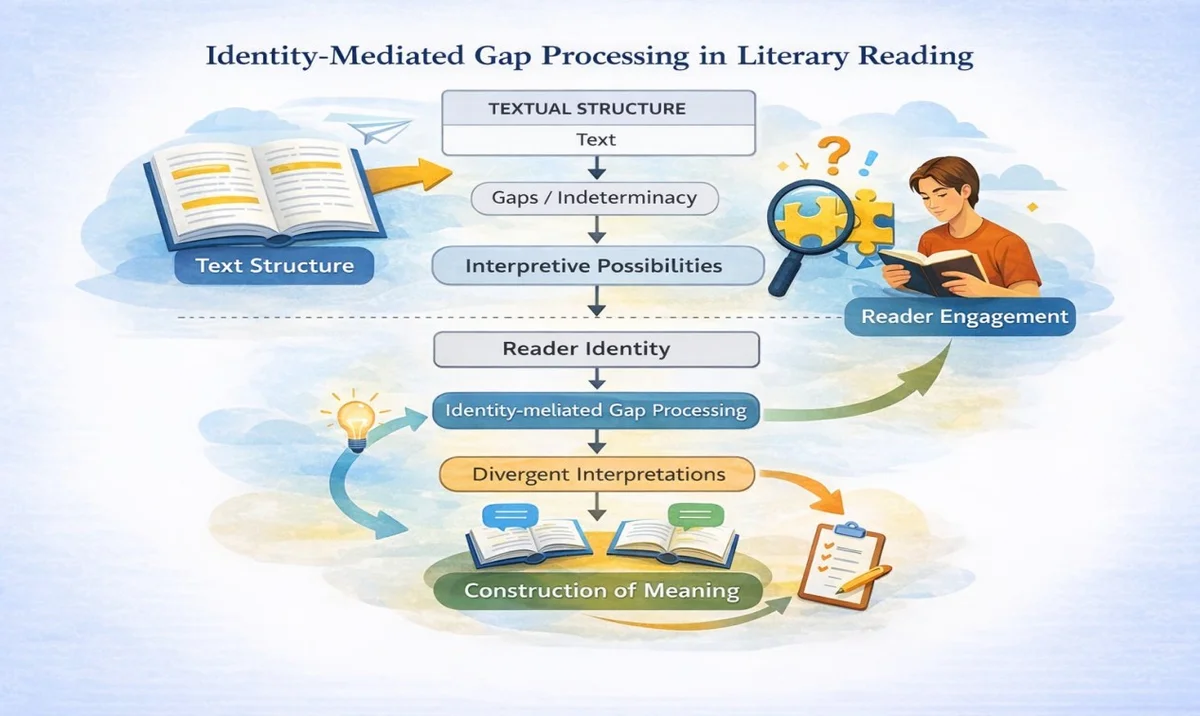
The complementary framework proposed here assigns Iser’s and Holland’s theories distinct but interrelated explanatory roles. Textual gaps account for the possibility of divergent interpretations, while identity-based responses account for their direction. Gaps create spaces that require completion; identity themes guide how those spaces are filled. Interpretive diversity thus emerges from the interaction between structured textual openness and patterned reader dispositions.
This synthesis challenges dominant tendencies in reading pedagogy that resolve interpretive diversity either by subsuming it under textual correctness or by celebrating it as unregulated personal response. By contrast, the present framework reconceptualizes divergence as a theoretically grounded outcome of text–reader interaction that demands instructional interpretation rather than interpretive closure.
By grounding interpretive evaluation in textual affordances, the framework preserves standards of plausibility and coherence. By recognizing identity-based response, it legitimizes diversity without treating all interpretations as equally warranted. Such interpretive divergence is therefore neither an error to be corrected nor a preference to be indulged, but an analytically meaningful response that reveal how texts and readers jointly produce meaning.
To move beyond a mere juxtaposition of Iser’s textual gaps and Holland’s identity-based responses, this article conceptually reconfigures their relationship through the notion of identity-mediated gap processing. From this perspective, reader identity functions as a mediating layer through which textual indeterminacy is activated, negotiated, and provisionally resolved during reading. Textual gaps do not operate in isolation; rather, they invite responses that are filtered through readers’ identity positions, investments, and affective orientations. Divergent interpretations, therefore, emerge not simply from the openness of the text or from individual subjectivity, but from the dynamic interaction between indeterminate textual cues and identity-mediated meaning construction in classroom contexts.
In this article, identity-mediated gap processing is examined specifically in the context of literary reading classrooms, where interpretive divergence is both pedagogically visible and institutionally consequential.
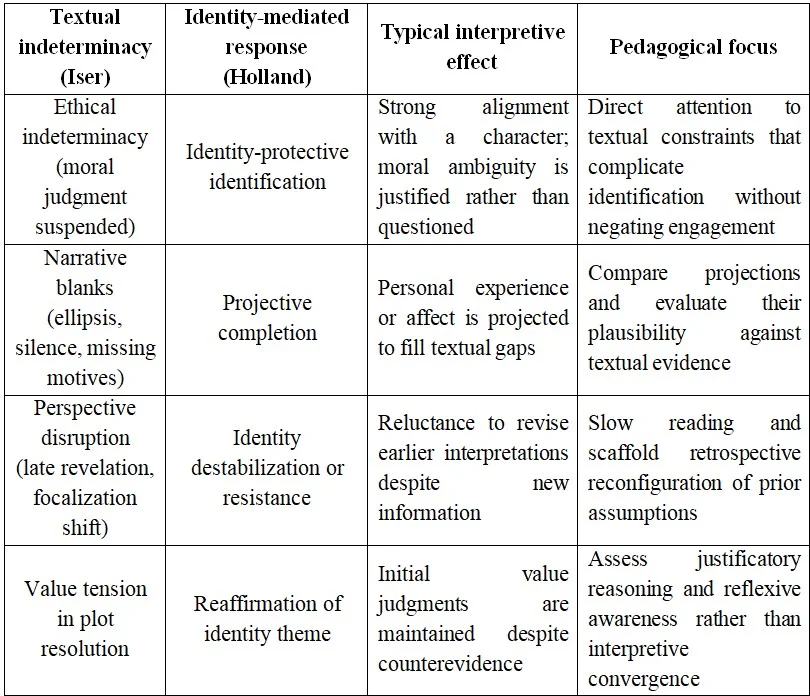
To clarify how identity-mediated gap processing becomes pedagogically observable, the following table brings together recurrent patterns of textual indeterminacy (after Iser), identity-based modes of reader response (after Holland), and their instructional significance. Interpretive divergence is thus approached not as error or miscomprehension, but as a systematic outcome of readers’ identity investments, indicating specific points at which pedagogical guidance can intervene to support reflective and textually grounded reading.
2.4. Illustrative textual cases: Identity-mediated gap processing in “The Little Prince” (Antoine de Saint‑Exupéry) and “The Story of a Seagull and the Cat Who Taught Her to Fly” (Luis Sepúlveda)
The dynamics of identity-mediated gap processing become more concrete when examined through literary works commonly taught in school curricula, such as The Little Prince and The Story of a Seagull and the Cat Who Taught Her to Fly. Both texts are structured around pronounced ethical and narrative indeterminacies that invite readers to complete meaning in ways shaped by their identity themes rather than by explicitly stated authorial judgments.
In The Little Prince, gaps emerge around the status of the prince’s relationship with the rose, the meaning of “taming,” and the implications of the prince’s disappearance. These moments of indeterminacy do not prescribe a single moral resolution; instead, they require readers to project values and experiences into the text. From an Iserian perspective, such gaps function as structured invitations that activate anticipation and retrospection in the reading process, while remaining constrained by the text’s symbolic repertoire. At the same time, Holland’s framework helps explain why students’ responses often diverge in patterned ways: identity-protective identification with the prince or the rose may lead some readers to construe possessiveness as care, whereas others project personal experiences of friendship, loss, or autonomy into the narrative blanks.
Comparable processes are evident in Sepúlveda’s story. The text withholds explicit commentary on the ethical legitimacy of interspecies adoption, loyalty to the cat community, and the risks entailed in teaching the seagull to fly. These narrative gaps invite projective completion, allowing readers to interpret the cats’ actions as unconditional solidarity, as resistance to exclusionary norms, or as an allegory of cross-cultural responsibility. Identity orientations shape which interpretive possibilities are privileged. Readers who strongly value obedience to communal rules, for example, may experience perspective disruption when confronted with the cats’ decision to break conventions, responding either with resistance or with a reassertion of prior value commitments.
Taken together, these cases illustrate how textual indeterminacy provides the structural conditions for interpretive plurality, while identity themes orient the direction in which gaps are resolved. They also anticipate the pedagogical issues examined in subsequent sections. When teachers intervene in classroom discussions of such texts, they are not merely correcting misunderstandings, but mediating how identity-inflected responses negotiate textual constraints. This insight underpins the framework’s implications for instructional design and its reconceptualization of evaluative judgment developed in Sections 3 and 4.
3. Pedagogical Implications
Having established how textual gaps and identity-based responses jointly generate patterned interpretive divergence (Section 2), the analysis now examines the pedagogical consequences of this framework. Section 3 focuses on how divergent interpretations can be interpreted, guided, and evaluated in classroom contexts without reverting to interpretive imposition or relativism. The integration of textual gaps and identity-based reader responses carries implications that extend beyond classroom technique to the underlying assumptions of reading comprehension instruction.
First, divergent interpretations should be approached as pedagogical data rather than instructional failure. Within this framework, variation in students’ readings signals active engagement with textual indeterminacy and reveals how different identity orientations mediate that engagement. Instructional rigor is thus relocated from enforcing interpretive convergence to evaluating the quality of students’ engagement with textual constraints.
Second, instructional guidance can be reconceptualized as directing attention to textual affordances rather than dictating interpretive outcomes. Teachers retain pedagogical authority by foregrounding gaps, ambiguities, and tensions that require interpretive work, while refraining from prematurely closing those spaces through authoritative explanation. This distinction enables guidance without imposition and openness without relativism.
Third, the framework challenges assessment models that equate comprehension with interpretive sameness. Evaluation is redirected toward interpretive plausibility, justification, and coherence, recognizing that validity emerges from the interaction between textual evidence and readerly orientation rather than from convergence on a single meaning.
Finally, adopting this framework implies a redefinition of teacher expertise. Expertise lies not in supplying correct interpretations, but in diagnosing how textual structures and reader identities interact in specific educational contexts. Such diagnostic expertise supports the cultivation of reflective readers who recognize both the openness of texts and the situated nature of their own meaning-making.
In sum, linking textual gaps with identity-based responses reframes reading comprehension as an interactive, interpretive, and socially situated practice. Divergent interpretations are no longer obstacles to be managed, but resources for deepening engagement with texts and for advancing a more theoretically coherent pedagogy of reading.
4. Discussion
This article advances a complementary account of divergent interpretations by integrating textual indeterminacy with identity-based reader response. In doing so, it intervenes in a long-standing tension within reading comprehension research between text-centered models that prioritize interpretive correctness and reader-centered models that emphasize personal response. The discussion below clarifies the article’s theoretical contribution, situates it within contemporary discourse, and outlines implications for future research.
4.1. Advancing the discourse on interpretive diversity
Research on reading comprehension has increasingly acknowledged interpretive diversity as an empirical reality of classroom practice. Yet theoretical explanations remain polarized. Text-oriented traditions have tended to frame comprehension as the accurate reconstruction of textual meaning, implicitly treating divergence as a problem of insufficient skill or knowledge. Reader-oriented traditions, by contrast, have foregrounded the legitimacy of personal response, sometimes at the cost of evaluative rigor. The framework proposed here challenges both tendencies by reconceptualizing divergence as an analytically meaningful outcome of text–reader interaction rather than as an instructional anomaly.
By assigning distinct explanatory roles to textual gaps and identity-based responses, the framework clarifies how interpretive plurality is generated and why it takes specific forms in classroom contexts. Textual indeterminacy explains the availability of multiple interpretive paths, while identity-based orientation explains the selection among those paths. This distinction moves the discourse beyond descriptive acknowledgment of diversity toward a principled account of its emergence.
4.2. Repositioning Iser and Holland within reading education
A further contribution lies in repositioning two influential theories—often treated as incompatible—within a shared pedagogical horizon. Reception theory associated with Wolfgang Iser has been widely cited in educational literature, yet frequently reduced to a generalized claim about reader activity without sustained engagement with textual constraints. Conversely, identity-based reader-response theory associated with Norman Holland has often been marginalized in educational contexts due to concerns about psychologism or relativism.
The present synthesis demonstrates that these concerns stem less from the theories themselves than from their partial application. When identity-based response is detached from textual affordances, it risks collapsing into subjectivism; when textual indeterminacy is detached from reader orientation, it risks being pedagogically neutralized through interpretive closure. Integrating the two restores their critical potential for reading education by showing how textual structure and reader identity jointly shape meaning-making.
4.3. Implications for evaluative judgment in reading comprehension
One of the most contested issues in reading pedagogy concerns evaluative judgment: how teachers can assess interpretations without enforcing uniformity or abandoning standards. The complementary framework offers a reframing of evaluation that may contribute to this debate. Instead of judging interpretations solely by convergence on an authorized meaning, evaluation can attend to the quality of engagement with textual gaps and the coherence of identity-driven reasoning.
This shift does not dilute rigor; rather, it relocates rigor from outcome to process. Interpretations are assessed by how plausibly they negotiate indeterminacy within the constraints of the text and by how reflexively readers articulate their interpretive stance. Such an approach aligns evaluation with the interpretive nature of reading itself and addresses long-standing concerns that assessment practices in reading comprehension implicitly suppress diversity.
4.4. Contribution to a non-reductive pedagogy of reading
At a broader level, the framework contributes to a non-reductive pedagogy of reading that resists simplifying comprehension into either textual mastery or personal expression. By conceptualizing reading as an interactive and socially situated practice, it aligns with contemporary emphases on learner agency while preserving the epistemic role of texts. Divergent interpretations are neither pathologized nor romanticized; they are treated as theoretically intelligible responses that can be pedagogically interpreted.
This stance has particular relevance in educational contexts where curricular reforms emphasize critical literacy and dialogic learning. The framework provides a theoretical rationale for classroom practices that value discussion, disagreement, and interpretive negotiation, while maintaining accountability to textual evidence. In this sense, it bridges a gap between progressive pedagogical ideals and the need for evaluative coherence.
4.5. Limitations and directions for future research
Several limitations should be acknowledged. First, the article develops a conceptual framework rather than reporting empirical findings. While the synthesis is grounded in established theories, its pedagogical claims would benefit from empirical investigation examining how teachers and students actually engage with textual gaps and identity-based responses in classroom interaction. Second, the framework does not exhaust the range of factors influencing interpretation, such as sociocultural context, instructional discourse, or institutional assessment regimes. These dimensions warrant further integration.
Future research could explore how the complementary framework operates across different educational levels, genres, and cultural contexts. Empirical studies might investigate how students’ identity-based orientations interact with specific types of textual indeterminacy, or how teachers’ diagnostic practices influence the productive use of interpretive diversity. Comparative research could also examine how assessment policies shape the viability of interpretation-based evaluation.
4.6. Concluding synthesis
In synthesizing textual gaps with identity-based reader responses, this article offers a theoretically grounded account of divergent interpretations that advances current discussions in reading education. It demonstrates that interpretive diversity is not merely an instructional challenge but a constitutive feature of reading that demands pedagogical interpretation rather than closure. By clarifying the interaction between textual affordances and reader orientations, the framework provides a basis for rethinking guidance, assessment, and teacher expertise in reading comprehension.
Ultimately, the contribution of this study lies not in proposing a new method, but in reframing a persistent problem through a complementary theoretical lens. Such reframing enables a more coherent understanding of reading as an interpretive practice and supports a pedagogy that treats divergence as a resource for learning rather than an obstacle to be managed.
5. Conclusion
This article set out from a recurrent concern in reading classrooms: the persistence of divergent interpretations and the tendency to frame such divergence as a pedagogical problem or a sign of insufficient comprehension. In response, the study has argued that interpretive difference should instead be understood as a theoretically intelligible outcome of literary reading, arising from the interaction between textual indeterminacy and reader identity.
By integrating Wolfgang Iser’s concept of textual gaps with Norman Holland’s identity-based response theory, the article has proposed a complementary framework that clarifies why divergence is not accidental or merely subjective, but structurally and psychologically grounded. Meaning does not pre-exist the act of reading, nor is it generated solely by the reader; rather, it emerges through readers’ identity-inflected engagements with textual indeterminacy. From this perspective, divergent interpretations are neither noise nor failure, but manifestations of how texts and readers jointly participate in meaning construction.
This reconceptualization carries important pedagogical implications. If divergence is intrinsic to literary reading, then instructional goals need not be framed around convergence on authorized meanings. Instead, reading instruction can foreground students’ capacities to articulate, justify, and revise interpretations in relation to textual evidence and alternative readings. Teachers’ roles thus shift from correcting difference to mediating interpretive dialogue, helping students become aware of how and why their readings take particular forms.
The argument also invites a rethinking of assessment practices. When divergent interpretations are treated as theoretically grounded, evaluation criteria must move beyond correctness toward the quality of interpretive reasoning, textual grounding, and reflexive engagement with difference. Such an orientation aligns with contemporary calls for dialogic, process-oriented approaches to reading assessment and classroom discourse.
While the present study is conceptual in nature, its contribution lies in reframing a familiar classroom phenomenon through a coherent theoretical lens. By explaining interpretive divergence rather than problematizing it, the article offers a principled basis for future empirical research on classroom interaction, reader identity, and assessment of interpretation. More broadly, it suggests that acknowledging and theorizing difference is not a pedagogical concession, but a necessary step toward a more adequate understanding of what it means to read literature in educational contexts.
Nguyen Phuoc Bao Khoi
Department of Literature, Ho Chi Minh City University of Education
Email: khoinpb@hcmue.edu.vn
References
Appleman, D. (2015). Critical encounters in secondary English: Teaching literary theory to adolescents (3rd ed.). Teachers College Press.
Beach, R. (1993). A teacher’s introduction to reader-response theories. National Council of Teachers of English.
Beach, R., Appleman, D., Hynds, S., & Wilhelm, J. D. (2016). Teaching literature to adolescents (3rd ed.). Routledge.
Connors, S. P. (2014). The politics of passing: Border crossing and the complex status of literary texts in the secondary English classroom. English Education, 46(3), 215–240.
Holland, N. N. (1973). Poems in persons: An introduction to the psychoanalysis of literature. W. W. Norton.
Holland, N. N. (1989). The dynamics of literary response (Rev. ed.). Columbia University Press.
Iser, W. (1974). The implied reader: Patterns of communication in prose fiction from Bunyan to Beckett. Johns Hopkins University Press.
Iser, W. (1978). The act of reading: A theory of aesthetic response. Johns Hopkins University Press.
Langer, J. A. (2011). Envisioning knowledge: Building literacy in the academic disciplines. Teachers College Press.
Luke, A., Woods, A., & Weir, K. (2013). Curriculum design, equity and the technical form of the curriculum. In A. Luke, A. Woods, & K. Weir (Eds.), Curriculum, syllabus design and equity: A primer and model (pp. 3–39). Routledge.
Nystrand, M. (2006). Research on the role of classroom discourse as it affects reading comprehension. Research in the Teaching of English, 40(4), 392–412.
Probst, R. E. (2004). Response and analysis: Teaching literature in secondary school (2nd ed.). Heinemann.
Rosenblatt, L. M. (1978). The reader, the text, the poem: The transactional theory of the literary work. Southern Illinois University Press.
Smagorinsky, P. (Ed.). (2011). Vygotsky and literacy research: A methodological framework. Sense Publishers.
Sumara, D. J. (2002). Why reading literature in school still matters: Imagination, interpretation, insight. Lawrence Erlbaum Associates.
Wilhelm, J. D. (2016). You gotta BE the book: Teaching engaged and reflective reading with adolescents (3rd ed.). Teachers College Press.
Yandell, J. (2020). The social construction of meaning: Reading literature in urban English classrooms. Routledge.
Young, M., & Muller, J. (2016). Curriculum and the specialization of knowledge: Studies in the sociology of education. Routledge.