
The first open economic zone of Vietnam
In the years following the reestablishment of Quảng Nam province (1997), the area of Eastern Quảng Nam at the time largely consisted of white sand with few buildings, sparse population and the main economic activity being agriculture, causing hardship for the lives of the people. The most basic favorable condition there at the time was a port (actually a small fishery port providing logistics for fishing) and the old Chu Lai military airport built during wartime. With the aim to find a path towards growth for this area and Quảng Nam province as a whole at the time, heading towards solving employment and exploiting advantages of the area at the same time. Given the condition of investing to build synchronized infrastructure to contribute to the resurgence of the local economy, Chu Lai – Núi Thành was chosen as the location to build the first Open Economic Zone of the country.
The Chu Lai Open Economic Zone (Chu Lai EOZ) was established according to Decision number 108/2003-QĐ-TTg on the 5th of June 2003 from the Prime Minister. It is an area with geographical borders belonging to national territory and sovereignty but has a dedicated economic space, with the most favorable investment and trading environment according to current regulations, including social and technical infrastructure, as well as regulations and mechanisms favorable for trade. This is suitable with the market mechanism, aiming to encourage investment and export. (1) This was the first OEZ in Việt Nam, determined to be one of the nuclei of the key economic zone of the Central region that were allowed to apply new models to act as impetus for growth when conditions did not allow for national implementation. The goal was to create high-quality products with high competitiveness to be exported to global markets.
22 years of development and growth
To soon construct and operate the Chu Lai OEZ, issues regarding institution, policies, finances, infrastructure, workforce, etc. had been promptly given attention, leadership, and direction by the Government, ministries, branches, Party committees, and local authorities. This was clearly shown via a host of mechanisms and policies that were enacted and applied to the Chu Lai OEZ such as: Decision number 43/2004/QĐ-TTg on 23rd 3 March 2004 of the Prime Minister regarding approval of the master plan for the construction of the Chu Lai OEZ in Quảng Nam; Decision number 1737/QĐ-TTg on 13th December 2018 of the Prime Minister, approving adjustments to the master plan of the construction of the Chu Lai OEZ in Quang Nam until 2035, with a vision towards 2050; Resolution number 09-NQ/TU on 18th May 2012 of the Quảng Nam Provincial Party Committee regarding the construction and development of the Chu Lai OEZ; Resolution number 07-NQ/TU in 4th May 2021 of the Quảng Nam Provincial Party Committee regarding development orientation of the Southeastern area until 2025, with a vision towards 2030, etc. The Chu Lai OEZ Management Committee was established to operate and manage the area directly in a timely manner. In 2021, on the basis of reorganizing the Chu Lai OEZ Management Committee, the Prime Minister established the former Quảng Nam province Economic and Industrial Zone Management Committee (now the Đà Nẵng Economic and Industrial Zone Management Committee.)
The initial plans for the Chu Lai OEZ included 14 communes, provinces and towns belonging to Núi Thành district and Tam Kì Town (part of the former Quảng Nam province) with 27.040 total hectares of natural land area. Operating in a multi-industry, multi-disciplinary manner, the Chu Lai OEZ is focused on the development and construction of the urban area, the automobile industrial center and supporting industries for the automobile and aviation industries; the center for gas-electricity and petrochemical products; textile and textile support industries as well as other industries utilizing advanced technology and high grey matter usage; and the center for tourism with close links to the utilization of the Chu Lai airport and the Kỳ Hà – Chu Lai port system. The Chu Lai OEZ consists into two zones: the Duty area and the Duty-free area (including industrial areas; ports and logistics areas; tourism and centralized service areas; urban areas; training centers; agricultural areas utilizing advanced technologies; residential areas, greenery areas, etc.) along with plans for unified electric grids, traffic and water supplies.
In the context of simultaneously experimenting and finding a suitable direction for growth after 22 years of operation, the Chu Lai OEZ has gradually built itself up and made important contributions into the socio-economic development of the former Quảng Nam province (now Đà Nẵng city) and the Central region. As of now, the Chu Lai OEZ has attracted 224 investment projects, with the total registered investment capital of about 93.126 billion VND (3,7 billion USD) and actual capital over 72.800 billion VND, comprising 62 FDI projects and 162 domestic projects. Some large investors include SGI (Korea) putting 110 million USD into magnet production, Ức Thịnh (China) investing 35 million USD into ultra-white flowered glass production, Karcher (Germany) with 21,38 million USD into cleaning devices, Hyosung with 410 million USD into a fabric production plant, and Panko with 70 million USD into a textile factory. The largest critical domestic project is the THACO Chu Lai automobile production context started in 2003; today, THACO Chu Lai has become a multi-industry group (automobiles, agriculture, mechanics, supporting industries, construction investment, commercial services, logistics) with 44 operational factories, contributing significantly into the annual budget revenue of the province (in 2025, THACO placed second in the top 50 private companies with the largest national budget payments in Việt Nam.)
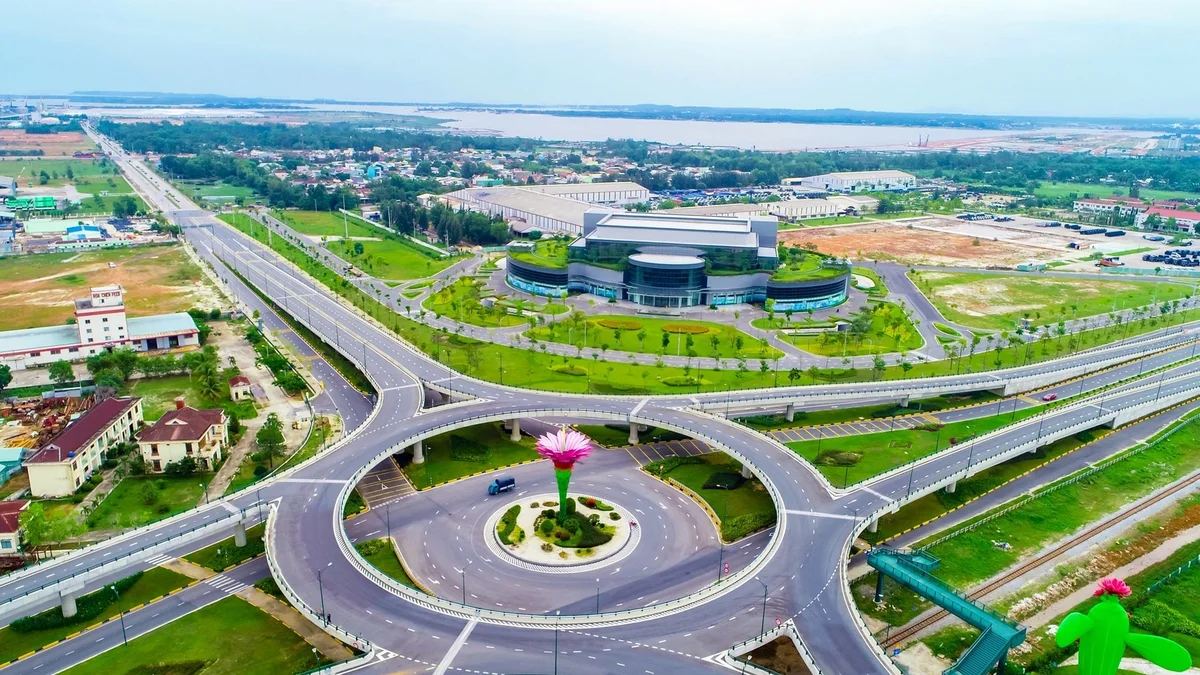
Across the Chu Lai AAO, 14 industrial areas have been established, with the total area measuring 3.462 ha. Of them, 7 industrial areas have gone into operation with the median occupation rate above 50%. Urban areas with projects such as Tui Robison, An Hòa Bay Eco Urban Area have also gone into operation, with other projects currently under deployment (Northeast Chu Lai Aiport Urban Area, Tam Hiệp Urban Area, etc.). The logistics and port areas with the Kỳ Hà port have seen investments into upgrades and expansion, ensuring the accommodation of cargo ships within 20.000 DWT. Chu Lai International Port, with an area of 140 ha and 2 specialized ports, including harbours serving containers with 50.000 DWT capacity and specialized harbour handling 30.000 DWT, as well as warehouse systems and logistic infrastructure, has become an important international transit route. In terms of the airport area, Chu Lai Aiport is deemed one of the three largest airports in the country according to 4F standards, serving 1,7 million domestic travelers a year. The traffic, electricity and water systems of the EOZ meets the essential needs for growth (the area is connected to the North-South unified railway, Đà Nẵng – Quảng Ngãi highway, the 1A national highway, the 616 provincial road to Tây Nguyên, etc.); There are 3 water plants supplying water for the Economic Zone; investments were made to construct transformers in Trường Hải, Chu Lai, Tam Hiệp, etc.). Supplying workforce for the OEZ are 2 large training centers (Chu Lai Trường Hải Vocational College and Quảng Nam Vocational College.) To provide medical aid for the residents and workers of the zone, alongside the General Hospital of the city, there is also the Quảng Nam Central General Hospital. Some resettlement sectors are in progress (Tam Anh Nam Resettlement Area and Worker Housing, Tam Thăng Resettlement Area) and one Tam Thăng Worker Housing Area project is already operating.
The mark made by the EOZ over those years was contributing to the change in the economic structure of the area, providing work for 45.000-50.000 workers, of which 65% is in industry, and contributing to 55-65% of the budget revenue of Quảng Nam each year. With large investments from the businesses within the EOZ, especially THACO Chu Lai, from 2017, Quảng Nam achieved budget autonomy and contributed to the Government budget.
Continuing to reach forward and retain the role of impetus for growth in Southern Đà Nẵng
In order to realize the policy of restructuring the national apparatus to ensure leanness, efficiency and efficacy; on the 1st of July, 2025, Quảng Nam province and Đà Nẵng merged into a new administrative unit. It has the largest area of the 6 centrally-governed cities, thereby providing additional space to grow the new unit named Đà Nẵng – the city with strengths in industry, high-tech industry and information technology (most notably, the Đà Nẵng High-tech Park, Chu Lai Open Economic Zone as well as the recently developed International Financial Center, along with other industrial zones currently in operation). The Chu Lai OEZ lies in the South of the new Đà Nẵng city, adjacent to the Chu Lai – Dung Quất Dynamic Zone and the Tây Nguyên area. The zone also lies in the industrial, urban and service development belt of the Central key economic region, is placed along strategic traffic routes and is a gateway to inter-regional and international trade. The current goal for the city is to turn Đà Nẵng into a center for free trade, international finance, industry, logistics and innovative startups as well as a high-class tourist city worth living in Asia. That would require making good use of the role of the Chu Lai EOZ – the impetus for growth in the south of the city in the period ahead.
Specifying the crucial orientations set out in the “Four Pillars” of the national development institutional framework regarding the “establishment of breakthrough, superior, and competitive mechanisms and policies for the international financial center, free trade zones, and key economic zones...”; “The State helps to create, serve, and support the rapid and sustainable development of the private economy, without administrative intervention in production and business activities contrary to market principles; building an open, friendly, accompanying and honest relationship between the government and enterprises, facilitating growth,” in order to continue promoting the role of a growth impetus in the south of the Chu Lai OEZ, it is necessary to focus on addressing the following fundamental issues:
First, a review and summary of the operation to carry out Resolution 01-NQ/TU should soon be made in order to become the basis for a new Resolution to guide the direction of construction and growth of the Zone; it will follow a similar model to the Đà Nẵng Free Trade Area with similar mechanisms applied to take advantage of its resources and meet the needs for growth of the city.
Second, the deployment of investment promotion activities should continue for coastal and riverside tourist city projects, multi-purpose mechanical automobile projects, high-tech industry, air services, ports and logistics, and agriculture with application of technologies and infrastructure suitable for the development orientation.
Third, focus should be put into improving administrative procedures and the investment environment, shortening the time taken to resolve these procedures and improving the quality of support services for businesses, and investors. Increase dialogue and remove obstacles for businesses and slow-moving projects, unleashing the potential of the first OEZ in the country.
Fourth, investment and completion of the infrastructure of the Chu Lai OEZ should continue, ensuring the best conditions for businesses to continue to operate.
Fifth, construct a management apparatus for the OEZ that can work effectively and efficiently, allowing for the best usage of the pioneering, daring and creative spirits of the cadres and Party members in their work
The 22-year mark left by the Chu Lai OEZ has asserted its role and position in developing the local and regional socio-economic situation. With the results achieved thus far, for the zone to continue its role as the impetus for growth in the South requires breakthroughs in institution, policies, workforce, finance infrastructure and more. It would also require changes in thinking and great determination from the Party Committee, the government and the People of the city, along with the care and facilitation of the State for the Chu Lai OEZ to continue to grow and make great leaps, contributing into the growth of Đà Nẵng into the role of the center and spearhead of the North Central and Central Coast regions, becoming a growth pole for Việt Nam.
By Văn Thị Nghĩa
Master Deputy Head of the Faculty of State and Law Đà Nẵng School of Politics
Translated by Nhat Nam