
By analyzing the political and legal foundations as well as the significance of implementing the merger policy - along with an assessment of initial outcomes and emerging challenges - this article also proposes several strategic directions to continue effectively restructuring the national administrative landscape in service of modern, efficient, and sustainable development goals.
Vietnam is entering a new phase of development that demands enhanced governance capacity, improved public investment efficiency, regional connectivity, and organizational reform of the administrative apparatus. The merger of administrative boundaries and implementation of a two-tier government system (province-commune or city-commune/ward) is a major policy of the Party and State in streamlining the state administrative apparatus. This is a crucial step toward renewing the political system, ensuring sustainable development, and enhancing the effectiveness and efficiency of state management at the local level. Strategically, it represents not only an organizational restructuring but also opens up new, modern, and more effective development opportunities.
Political and Legal Foundations for the Reform of the Political System and Merger of Administrative Units
***
On political grounds: It is clear that the merger of provincial-level administrative units is not merely a technical administrative task but a concrete step to realize the political system reform agenda set by the Communist Party of Vietnam over multiple terms. The core of this policy is clearly expressed in Resolution No. 18-NQ/TW dated October 25, 2017, of the 6th Plenum of the 12th Central Committee on “Some issues on continuing to renovate and streamline the organizational apparatus of the political system for more efficient and effective operation.” This resolution emphasizes the need to:
“Restructure district - and commune-level administrative units that do not meet standards in order to streamline the apparatus, enhance state management efficiency, and better serve the people.”
Since then, this restructuring effort has achieved significant results. Two rounds of administrative unit reorganization at the district and commune levels have been carried out from 2019–2021 and 2023–2025. As a result, the number of district-level units has been reduced from 713 to 696, and the number of commune-level units has decreased from 11,162 to 10,035.
Moreover, since 2023, continued directives such as Conclusion No. 48-KL/TW dated January 30, 2023, by the Politburo, have emphasized the “reasonable merger” of provincial-level units to create administrative units of appropriate scale, meet new development demands, reduce administrative layers, overcome resource fragmentation, and enhance governance effectiveness.
The year 2025 marks a new milestone with Conclusions No. 126-KL/TW and 127-KL/TW by the Politburo and the Secretariat on further streamlining and restructuring the administrative apparatus. These conclusions clearly set out the requirement to study the removal of the intermediate administrative level (district), continue reorganizing the commune level to fit new organizational models, and merge certain provincial-level administrative units.
The Party’s policy on reforming the political system reflects an objective trend in the modernization, urbanization, and digitalization of state management. This demands that the administrative structure align with development realities, integration needs, and the requirement to reduce the cost of operating the public system.
On legal grounds: The merger of provincial-level administrative units is governed by Vietnam’s current legal system, most notably the Law on the Organization of Local Government (2015, amended in 2019). This law sets out important legal criteria for reorganizing administrative units, including minimum standards for natural area and population size. Provinces that fail to meet both standards are considered for merger.
In addition, Resolution No. 1211/2016/UBTVQH13 of the National Assembly Standing Committee provides detailed guidance on the standards and classification of administrative units. Specifically, for provinces, the minimum standards are:Natural area: at least 8,000 km² Population: at least 1,400,000 people. If a unit fails to meet both of these criteria, it is subject to reorganization. Furthermore, the Law on the Organization of the National Assembly (2014, amended 2020) stipulates that the National Assembly has the highest authority to decide on adjustments to administrative boundaries, including the merger, division, or establishment of new administrative units. Meanwhile, the Law on Promulgation of Legal Documents (2015, amended 2020) plays a key role in ensuring transparency and legality in the formulation and issuance of legal documents related to mergers, such as resolutions of the National Assembly and Government, or guidance documents from ministries and agencies.
Implementation
***
Practical experience over nearly half a century has shown that the division of administrative units contributed to the goals of political security and local governance. However, this fragmented organizational model has now revealed several limitations: many provinces are small in scale, with low population and insufficient area standards, making it difficult to form key economic regions. This leads to dispersed investment with low efficiency; a cumbersome administrative apparatus; and high recurrent expenditures, which account for up to 70% of total budget spending-limiting resources available for development investment. Therefore, reorganizing administrative units today will help reshape development space toward greater connectivity, optimal resource utilization, and maximizing the advantages of scale.
In the implementation of administrative unit mergers, the Government plays the coordinating and executive role, specifically assigning the Ministry of Home Affairs as the focal agency to coordinate with localities in developing provincial-level administrative unit reorganization plans. Provinces and cities involved are required to organize public consultations on the proposed plans to ensure social consensus and democratic principles in the reform process. This step is considered mandatory and must be done in a substantive and meaningful way.
After a proposal is developed and approved by the provincial People’s Council and submitted to the Ministry of Home Affairs for appraisal and submission to the Government, the Government then presents it to the National Assembly for review and decision-making in accordance with legislative procedures. During the 2019–2021 period alone, the National Assembly Standing Committee issued a total of 48 resolutions on reorganizing district- and commune-level administrative units nationwide.
In implementation of Resolution No. 18-NQ/TW of the 12th Central Committee and Resolution No. 37-NQ/TW of the Politburo dated December 24, 2018, on reorganizing district - and commune-level administrative units that fail to meet standards, the Government directed the first phase of streamlining the administrative apparatus through mergers of district and commune units across the country. Based on review results, provinces and cities developed detailed proposals, organized voter consultations, and submitted them to the National Assembly Standing Committee for consideration and approval.
As a result of the Government’s direction and National Assembly decisions, during the 2019–2021 phase, a total of 21 district-level and 1,056 commune-level administrative units in 45 centrally governed provinces and cities were reorganized. This led to the reduction of 8 district-level units and 561 commune-level units, contributing to the streamlining of local governments, reduction of indirect staffing, savings in budget expenditures, and improvement of state management effectiveness at the grassroots level.
In July 2023, under the assignment of the Politburo and the Government, the Ministry of Home Affairs was tasked with developing a pilot proposal to merge certain provinces that fail to meet both criteria on natural area and population scale, as stipulated in Resolution No. 1211/2016/UBTVQH13. A notable new aspect of this proposal is that the pilot merger is placed in the context of regional development, national planning orientation, transport infrastructure development, and regional linkage potential. Therefore, provincial mergers are no longer limited to administrative and organizational goals but also serve as a regional socio-economic development strategy aligned with the nation’s long-term vision for spatial distribution and regional competitiveness.
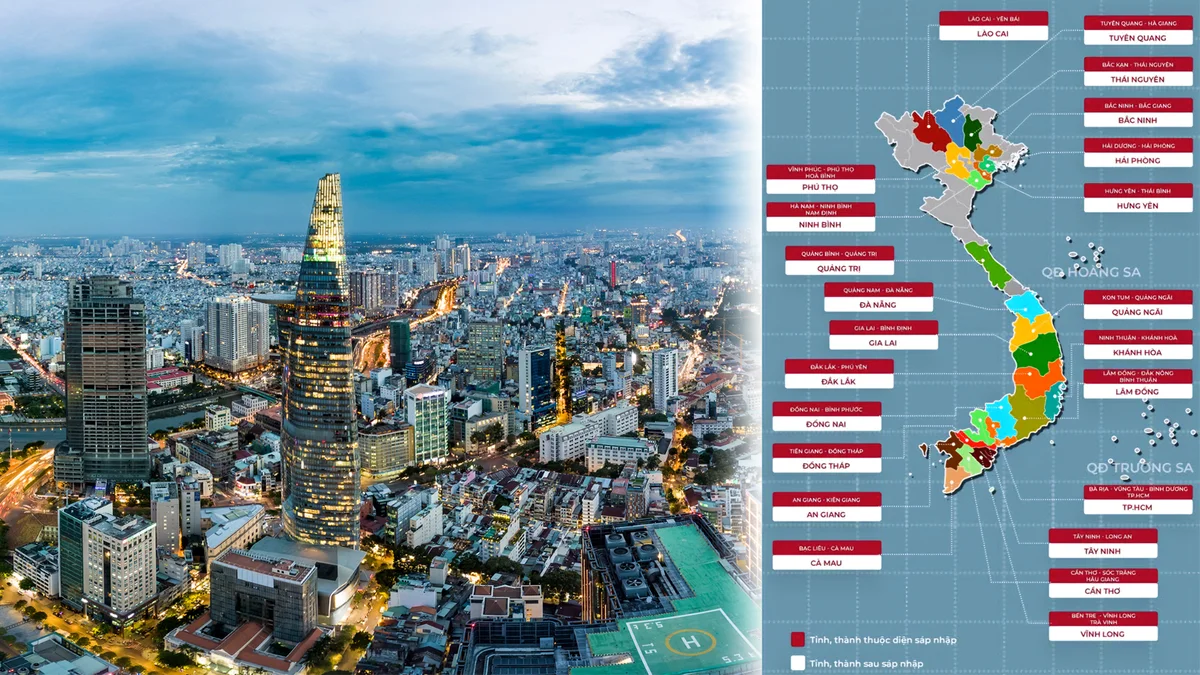
Building on the successes of this pilot phase, Vietnam has now entered a new, more strategic and comprehensive stage-specifically, the merger of provincial-level administrative units to realize the objective of streamlining the apparatus at the highest level of the local administration system. On June 12, 2025, the 15th National Assembly passed Resolution No. 202/2025/QH15 on merging 52 provincial-level administrative units into 34 new units (comprising 28 provinces and 6 centrally governed cities), effective immediately upon signing. Results from public consultations and votes in local People’s Councils showed a high consensus rate of 96.19%, with 100% of local People’s Councils voting in favor of the merger plan.
Nature and Significance of the Merger of Administrative Boundaries and Implementation of the Two-Tier Government System
***
The merger of administrative units is a comprehensive administrative reform process. It is not merely a territorial boundary adjustment but involves restructuring the organizational apparatus, personnel system, and administrative management methods. Moreover, this is not a temporary solution but a strategic direction aimed at improving the quality of local governance. In other words, the current merger of provinces and cities is not simply an addition of land area and population, but a “multiplication” of GDP. Post-merger provinces will have more diverse natural conditions and resources, facilitating the development of socio-economic plans, attracting investment, and reorganizing the production–services space in a more rational and sustainable manner. This reform will also promote the restructuring of the administrative system, institutional reform, and the completion of a streamlined, transparent, and modern governance model.
The administrative unit merger affects multiple areas: from the organization of the state apparatus and socio-economic aspects to cultural life and national defense and security, all experience significant changes after the merger and the reorganization of local government structures.
The merger of provinces helps streamline the administrative apparatus and reduce budget expenditures. One of the most evident benefits is the cost savings in operating the state apparatus. Merging provinces reduces the number of provincial-level administrative and socio-political organizations, leading to staff reductions and easing the budget burden on the State. Each successful provincial merger can save hundreds of billions of VND annually in recurrent expenditures such as salaries, allowances, office and facility costs. These savings can then be redirected to invest in economic development, infrastructure, and social welfare.
Another major benefit of provincial mergers is the improvement in management and governance effectiveness. When a province’s scale expands, the organizational and operational capacity of the local government apparatus also improves. Policies will be planned on a more comprehensive and long-term basis, aligned with the potential and advantages of the regional linkage. Merging provinces also fosters regional connectivity and economic development. When localities with similarities in geography, culture, and economic potential are merged, larger-scale economic and administrative centers are formed-more capable of attracting investment and achieving sustainable development. This aligns with the national development strategy of regionalization and urbanization, reducing resource fragmentation and enhancing the competitiveness of the economy.
Additionally, merging provinces will serve as a stepping stone for building a modern governance system-people-centered and driven by digital transformation. The reorganization of public service systems will move toward greater professionalism and convenience, thereby improving the quality of services provided to citizens and businesses.
The merger of provinces and cities is an important policy in the administrative reform process, aiming to streamline the state apparatus, enhance the effectiveness and efficiency of public administration, and improve public service delivery. However, the merger process not only brings organizational and managerial benefits but also poses challenges in administering large and culturally diverse territories. To maximize the effectiveness of the mergers, attention should be paid to the following issues:
• Improve the legal framework on administrative unit mergers to ensure consistency, uniformity, and practicality.
• Develop clear and flexible mechanisms for decentralization and delegation in state management to meet the needs of managing large territories.
• Enhance the application of information technology and digital transformation in public administration to increase operational efficiency and improve the quality of public services.
• These recommendations aim to ensure that the merger process is smooth and effective, contributing to the development of a streamlined, efficient, and effective state apparatus during the country’s new stage of development.
A Significant Milestone
***
According to the resolution, the newly established administrative units will officially come into operation on July 1, 2025. This can be described as a “historic moment”-a crucial milestone marking the legal and personnel completion of the provincial-level merger process. July will be a pivotal time for implementing the next specific steps of the plan, starting with the official operation of new government agencies, the handover of assets and facilities, and the reorganization of national data systems.
According to data from the Ministry of Home Affairs by mid-2025, following the mergers, the country will reduce approximately 4,226 public office buildings. The staffing structure will also be adjusted, with a roadmap to streamline about 10–15% of indirect personnel over a five-year period. This restructuring will significantly reduce recurrent expenditures, especially administrative costs such as salaries, allowances, and office operations. The saved resources can then be redirected toward development investment, infrastructure improvement, education, healthcare, and digital transformation.
In addition, the merger of provincial-level administrative units provides favorable conditions for restructuring the local government apparatus in a streamlined manner-reducing organizational layers and enhancing operational efficiency and budget oversight. When two or more provinces are merged, departments and agencies will be reorganized according to streamlined principles, eliminating overlaps and reducing the number of leadership positions, particularly at the provincial level. Alongside this, the merging of local budgets helps increase financial scale and enhances the ability to balance and coordinate regional budgets. Localities that previously depended heavily on central government funding may, after the merger, achieve a higher level of financial autonomy by leveraging larger economic scales and expanded revenue capacities.
The post-merger government apparatus will not only handle a larger workload but will also be restructured toward greater professionalism, integration, and strengthened overall governance capacity. Specifically:
• First, reducing the number of administrative units helps eliminate overlapping functions and responsibilities among agencies, while also improving interconnection and coordination between different levels of government.
• Second, a larger province will find it easier to implement regional management mechanisms, comprehensive planning, and intersectoral development coordination. Provincial-level management agencies will be reorganized to be more specialized, with investments in human resources and technology appropriate to the new management scope, thereby enhancing policy-making capacity, responsiveness, and proactivity in addressing emerging issues (such as pandemics, natural disasters, and investment shifts).
• Third, concentrating administrative authority in a larger unit also enhances the consistency of directives and operations, reduces the fragmentation of resources between bordering localities, and limits the phenomenon of “administrative fiefdoms.”
The merger of provinces and cities is an important policy in the administrative reform process aimed at streamlining the state apparatus, improving the effectiveness and efficiency of public administration, and enhancing the quality of public services. However, while the merger process brings clear organizational and managerial benefits, it also presents significant challenges in governing and managing large and culturally diverse territories. Therefore, it requires a high level of focus and coordination from the entire political system and active participation from all sectors of society to effectively implement this crucial policy.
By PhD. Dang viet Nga